
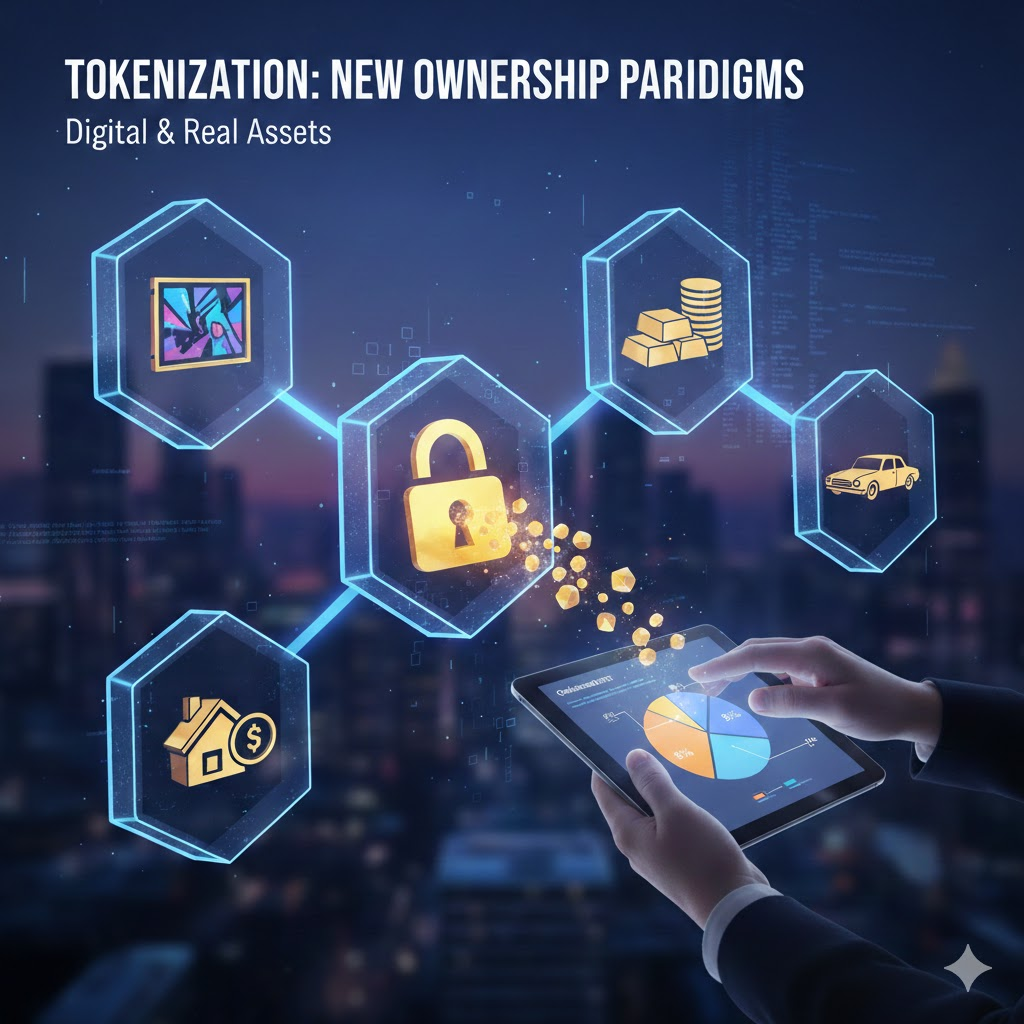
Ownership is going through a quiet revolution. For centuries, owning something meant holding a physical object or having your name written on a legal document stored in a registry. Today, that idea is being reshaped by a new concept called tokenization. By turning ownership rights into digital tokens on a blockchain, assets of almost any kind can be divided, traded, and managed in ways that were never possible before.
From artwork and music to real estate and company shares, tokenization is redefining who can own what and how easily that ownership can change hands.
What is tokenization in simple terms
Tokenization is the process of creating a digital representation of an asset on a blockchain. This digital representation is called a token. Each token carries information that proves ownership or a share of ownership in a specific asset.
Think of a token as a secure digital certificate. Instead of a paper title deed for a house or a printed share certificate for a company, ownership is recorded as a token in a decentralized ledger. This ledger is transparent, tamper resistant, and accessible from anywhere in the world.
These tokens can represent purely digital assets like virtual land in online worlds, or real world assets like property, gold, or fine art.
Breaking big assets into small pieces
One of the most powerful effects of tokenization is fractional ownership.
Traditionally, buying a commercial building or a famous painting requires huge amounts of capital. Only wealthy individuals or large institutions could participate. With tokenization, that same building or painting can be divided into thousands or even millions of tokens. Each token represents a small slice of the asset.
This means someone can invest a modest amount and still become a partial owner of a skyscraper, a luxury villa, or a rare collectible. Ownership becomes more inclusive and accessible to everyday investors.
Easier and faster trading
Selling a physical asset is often slow and complicated. Property sales involve paperwork, lawyers, banks, and waiting periods. Selling shares in private companies can be even harder because there is often no active marketplace.
Tokenized assets can be traded on digital platforms almost instantly. Transfers happen directly between buyers and sellers through smart contracts. These are self executing pieces of code on the blockchain that automatically enforce the rules of the transaction.
There is no need for multiple intermediaries to confirm and clear the trade. As a result, transactions can be faster, cheaper, and more transparent.
Global access to investment opportunities
Tokenization removes many geographical barriers. In the past, investing in foreign real estate or niche assets in another country was complex and sometimes impossible for small investors.
With blockchain based tokens, anyone with an internet connection and access to a compliant platform can buy and sell tokenized assets, subject to local regulations. This creates a more global marketplace where capital can flow more freely and opportunities are not limited to local buyers.
For asset owners, this means access to a much larger pool of potential investors.
Improved liquidity for illiquid assets
Some assets are considered illiquid because they are hard to sell quickly without losing value. Real estate, private equity, and collectibles fall into this category.
Tokenization can add liquidity by enabling partial sales. Instead of selling an entire property, an owner can sell a portion of their tokens to raise cash while still keeping a stake in the asset.
This flexibility can make previously static investments more dynamic and responsive to changing financial needs.
Greater transparency and security
Blockchain technology records every token transaction in a public and verifiable ledger. This creates a clear history of ownership that is extremely difficult to alter or fake.
For buyers, this reduces the risk of fraud and double selling. For sellers and issuers, it builds trust with investors because ownership and transfer records are always visible and auditable.
Smart contracts also reduce human error by automatically handling tasks like dividend distribution, rental income sharing, or royalty payments according to predefined rules.
New models of community ownership
Tokenization is not only about finance. It also enables new social and community driven ownership models.
A group of fans can collectively own part of a sports club. A community can jointly buy and manage a local renewable energy project. Artists can sell tokens that give supporters both ownership and special access or benefits.
This turns passive consumers into active stakeholders and creates stronger alignment between creators, users, and investors.
Impact on real world assets
In real estate, tokenization is already being used to fund property development and allow investors to buy small shares of rental properties. Rental income can be distributed automatically to token holders.
In commodities, gold or other precious metals can be stored in secure vaults while tokens represent direct ownership of a specific amount of the physical asset.
In finance, traditional securities like bonds and funds are being explored in tokenized form to simplify settlement and reduce operational costs.
Challenges and the road ahead
Despite its promise, tokenization still faces hurdles.
Regulation is evolving and varies by country. Legal recognition of tokenized ownership needs to be clear and enforceable. Secure custody solutions are required to protect digital assets from hacking or loss of private keys.
There are also technical challenges around scalability and interoperability between different blockchain networks.
However, progress is steady. Financial institutions, technology firms, and regulators are actively working on standards and frameworks that could bring tokenization into the mainstream.
A shift in how we think about ownership
At its core, tokenization changes ownership from something heavy and static into something flexible and programmable.
Assets can be divided, shared, traded, and managed with unprecedented ease. More people can participate in markets that were once reserved for a select few. Transactions can happen faster and with greater trust.
As infrastructure matures and rules become clearer, tokenization has the potential to transform not just investing, but the very idea of what it means to own something in a digital world.
Frequently Asked Questions
1. What types of assets can be tokenized?
Almost any asset can be tokenized, including real estate, company shares, art, music rights, commodities like gold, intellectual property, and purely digital items such as virtual land or in game assets.
2. Is tokenized ownership legally valid?
In many jurisdictions, tokenized ownership can be legally valid if it is structured to comply with local laws and regulations. Legal frameworks are still developing, so compliant platforms link tokens to enforceable legal agreements.
3. How is tokenization different from cryptocurrencies?
Cryptocurrencies like Bitcoin are standalone digital currencies. Tokenization represents ownership of a specific underlying asset. A token might represent a share of a building or a piece of artwork rather than acting as money.
4. Can I sell my tokens anytime?
On platforms that provide active secondary markets, you can often sell your tokens whenever there is a buyer. Liquidity depends on demand, platform rules, and regulatory restrictions.
5. Is tokenization safe?
Blockchain records are highly secure and hard to tamper with. However, safety also depends on secure storage of your private keys, the reliability of the platform you use, and strong legal and regulatory compliance.
6. Do I need a lot of money to invest in tokenized assets?
No. One of the main benefits is fractional ownership. You can often start with small amounts because assets are divided into many affordable tokens.
7. How do I earn returns from tokenized real estate?
Returns can come from rental income distributed to token holders and from appreciation in the property value if you sell your tokens at a higher price later.
8. Will tokenization replace traditional ownership systems?
It is more likely to complement and gradually upgrade them. Traditional registries and legal systems will integrate with blockchain based records rather than disappear overnight.
Tokenization is still early, but it is already reshaping how ownership is created, shared, and transferred. As adoption grows, owning a fraction of almost anything could become as simple as buying a digital token.