
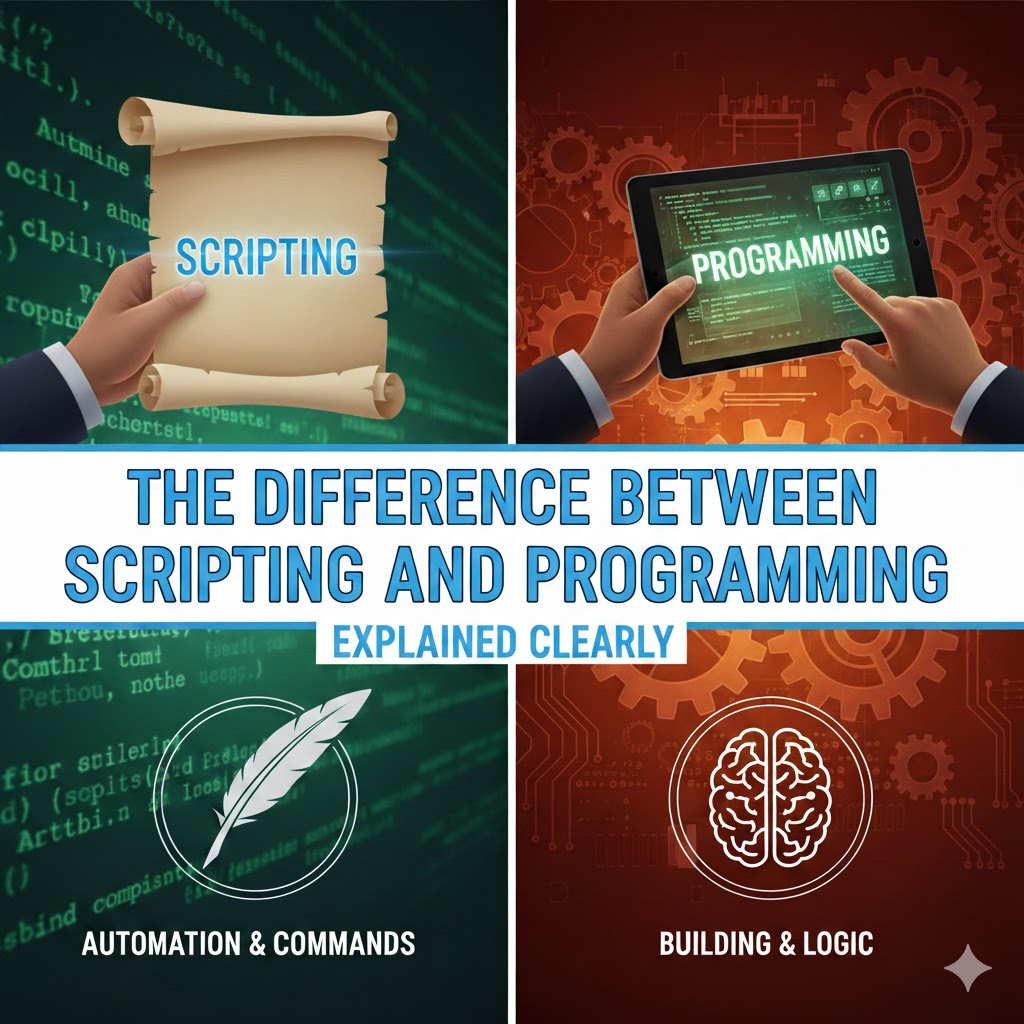
In the world of software development, the terms scripting and programming are often used interchangeably but they are not the same. Understanding the difference can help beginners choose the right tools, improve workflow efficiency, and write better software.
By 2026, with automation, AI, and cloud technologies becoming mainstream, distinguishing between scripting and programming is more important than ever. Both have unique purposes, strengths, and use cases, and knowing when to use each can make a significant difference in productivity and project success.
What Is Programming?
Programming is the broader process of writing instructions for a computer to perform tasks. It often involves creating complex, compiled software with extensive features, error handling, and architecture.
Key characteristics of programming:
- Uses languages like Java, C++, Go, or Rust.
- Programs are usually compiled into machine code.
- Focuses on creating standalone applications or large-scale systems.
- Requires careful planning, design, and testing.
Examples of programming:
- Building a desktop application like Photoshop or VS Code.
- Developing enterprise software for accounting or logistics.
- Writing system-level software such as operating systems or drivers.
Programming emphasizes structure, scalability, and efficiency.
What Is Scripting?
Scripting is a type of programming focused on automating tasks, manipulating existing software, or controlling specific environments. Scripts are generally interpreted, not compiled, and are often used for repetitive or small-scale tasks.
Key characteristics of scripting:
- Uses languages like Python, JavaScript, Bash, or PowerShell.
- Scripts are interpreted, running line by line.
- Often used to automate tasks, manage systems, or manipulate files.
- Typically simpler and shorter than full-scale programs.
Examples of scripting:
- Automating file backups or system maintenance.
- Running data analysis or batch processing tasks.
- Writing small web automation scripts to scrape information or test APIs.
Scripting emphasizes speed, convenience, and task automation.
Key Differences Between Scripting and Programming
| Feature | Programming | Scripting |
| Purpose | Build complex software and systems | Automate tasks or manipulate existing programs |
| Languages | Java, C++, C#, Rust | Python, JavaScript, Bash, PowerShell |
| Execution | Compiled into machine code | Interpreted line by line |
| Complexity | High; requires design, architecture | Usually simpler and focused on task execution |
| Development Time | Longer due to planning and debugging | Shorter; quick to write and run |
| Error Handling | Robust error management | Basic or minimal error handling |
| Use Case | Applications, software products, enterprise solutions | Automation, scripting pipelines, web automation, data processing |
When to Use Programming vs Scripting
Use Programming When:
- You are building a large, standalone application.
- Performance and scalability are critical.
- You need robust architecture and error handling.
- The project requires long-term maintenance and multiple collaborators.
Example: Developing a cross-platform mobile app or enterprise inventory management system.
Use Scripting When:
- You need to automate repetitive tasks quickly.
- You want to manipulate files, databases, or web pages.
- Speed and convenience are more important than efficiency.
- You are performing data analysis, batch processing, or system administration tasks.
Example: Writing a Python script to clean a dataset before running machine learning models.
How the Lines Between Scripting and Programming Have Blurred
In modern development, the distinction is becoming less rigid. Languages like Python and JavaScript can be used for both scripting and full-scale programming:
- Python can automate tasks and build complex web apps using Django or Flask.
- JavaScript can run scripts in browsers and power full-scale applications using Node.js.
The choice now often depends more on project scope and purpose than the language itself.
Best Practices for Writing Scripts and Programs
For Scripts:
- Keep scripts modular and reusable. Avoid writing one-off scripts that are difficult to maintain.
- Include comments to explain steps, especially for automation tasks.
- Handle basic exceptions to prevent scripts from crashing unexpectedly.
- Test scripts in a safe environment before running on production systems.
For Programs:
- Design a clear architecture before writing code.
- Write clean, maintainable code with meaningful variable names.
- Implement robust error handling and logging.
- Use version control and testing frameworks to manage changes and ensure stability.
Why Understanding the Difference Matters
- Tool Choice: Selecting the right language and environment speeds up development.
- Efficiency: Scripts reduce repetitive work, while programs create scalable solutions.
- Collaboration: Understanding whether a task requires a script or full program helps teams organize work effectively.
- Career Growth: Employers value developers who can distinguish between building complex software and automating workflows.
Frequently Asked Questions
Can scripting languages be used for programming?
Yes. Languages like Python, JavaScript, and Ruby can be used both for scripting and for full-scale applications depending on how they are applied.
Is scripting easier to learn than programming?
Generally, yes. Scripting languages often have simpler syntax and focus on practical, immediate results. Programming requires understanding architecture and design principles.
Are scripts slower than programs?
Interpreted scripts can be slower than compiled programs. However, for many automation or small tasks, the speed difference is negligible.
Can a script evolve into a full program?
Absolutely. Many software projects start as small scripts and grow into full applications as requirements expand.
Does scripting require error handling?
Yes, but typically less extensive than large-scale programming. Basic exception handling helps prevent crashes during automation tasks.
Final Thoughts
Scripting and programming are both essential skills in 2026. While scripting focuses on automation and efficiency, programming emphasizes structure, scalability, and robust application development.
Understanding the difference allows developers to choose the right approach, reduce errors, save time, and create software that is both functional and maintainable.
In today’s hybrid world, many developers use a combination of both: scripts to automate repetitive tasks and programs to build long-term, scalable solutions. Mastering both skills gives you flexibility, efficiency, and professional versatility.