
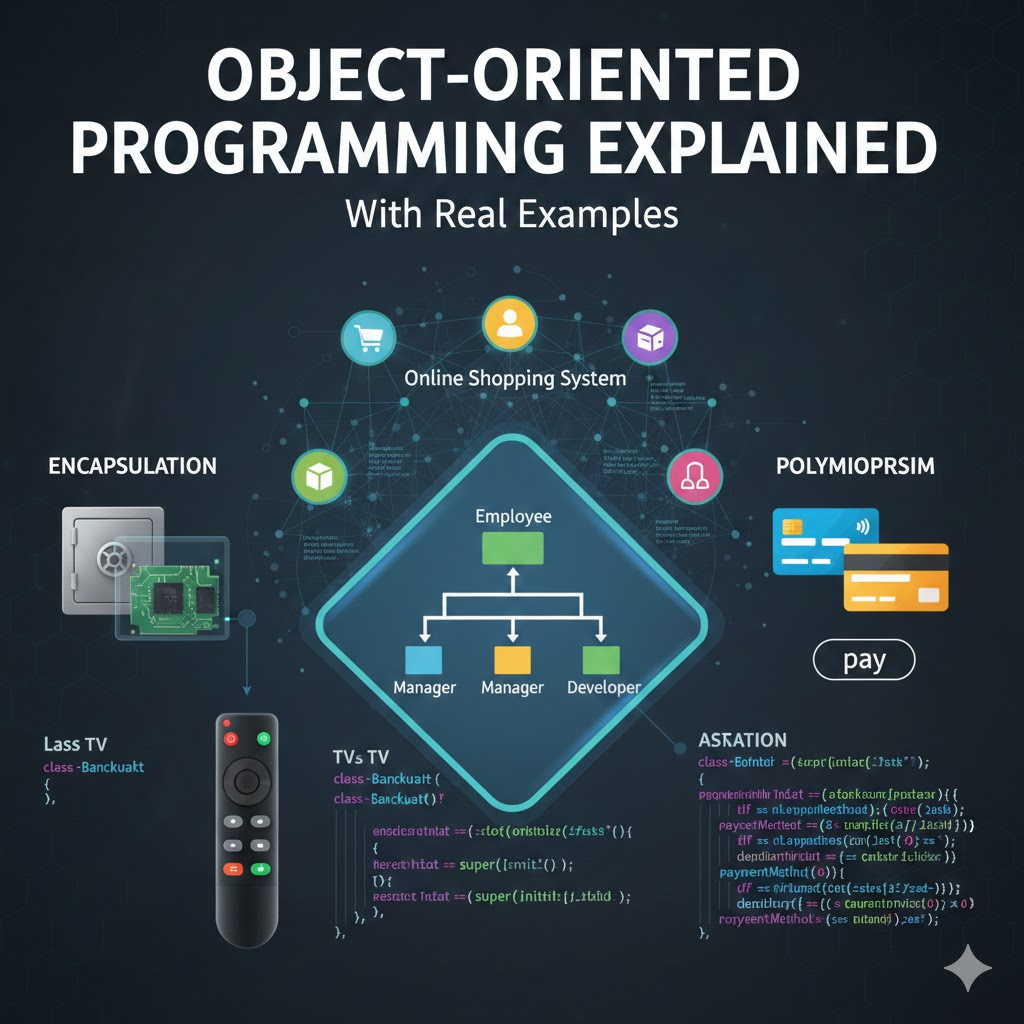
In the world of software development, Object-Oriented Programming (OOP) is one of the most widely used programming paradigms. Whether you are building web applications, mobile apps, or even games, understanding OOP can make your code cleaner, more organized, and easier to maintain.
But what exactly is OOP, and why is it so powerful? Let’s break it down using simple explanations and real-life examples.
What is Object-Oriented Programming?
At its core, Object-Oriented Programming is a way of designing software by modeling it around objects. An object is a self-contained unit that contains data (known as attributes or properties) and behavior (known as methods or functions).
Think of objects as real-world things. For example, a car has properties like color, make, and model, and behaviors like start, stop, or accelerate. OOP allows you to represent these real-world entities in code.
The Four Pillars of OOP
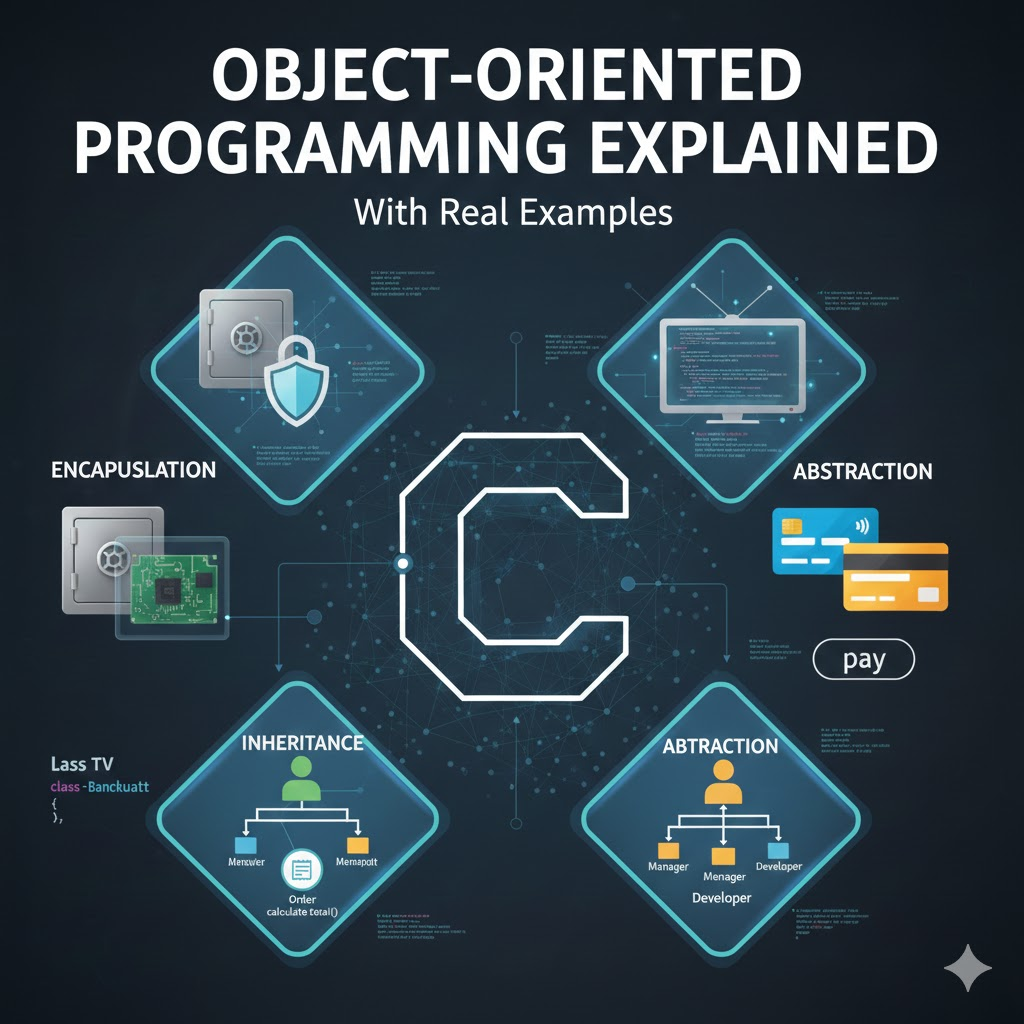
OOP is built on four fundamental concepts: Encapsulation, Abstraction, Inheritance, and Polymorphism. Let’s explore each one with real-world analogies.
1. Encapsulation
Encapsulation is the idea of keeping data and behavior together in one place and restricting access from outside. This helps protect your data from being altered unexpectedly.
Real Example:
Consider a bank account. It has properties like balance and account number, and methods like deposit and withdraw. You wouldn’t want someone to directly change the balance; they should go through controlled methods.
class BankAccount:
def __init__(self, balance):
self.__balance = balance # private attribute
def deposit(self, amount):
self.__balance += amount
def withdraw(self, amount):
if amount <= self.__balance:
self.__balance -= amount
return amount
else:
return “Insufficient balance”
def get_balance(self):
return self.__balance
# Usage
account = BankAccount(1000)
account.deposit(500)
print(account.get_balance()) # Output: 1500
Here, the __balance is hidden from the outside world and can only be modified through deposit or withdraw.
2. Abstraction
Abstraction means hiding unnecessary details and showing only what is essential. It allows programmers to work with complex systems without worrying about the inner workings.
Real Example:
Think of a TV remote control. You press buttons to change the channel or volume, but you don’t care how the TV processes the signals internally.
class TV:
def turn_on(self):
print(“TV is ON”)
def change_channel(self, channel):
print(f”Changing to channel {channel}”)
# Usage
tv = TV()
tv.turn_on()
tv.change_channel(5)
Here, you interact with simple methods, but the complex electronics inside the TV are abstracted away.
3. Inheritance
Inheritance is a mechanism where one class can inherit properties and behaviors from another class. It allows code reusability and the creation of hierarchical relationships.
Real Example:
Imagine a company with employees. There are managers and developers. Both are employees, but managers have additional responsibilities.
class Employee:
def __init__(self, name, salary):
self.name = name
self.salary = salary
def work(self):
print(f”{self.name} is working”)
class Manager(Employee):
def __init__(self, name, salary, department):
super().__init__(name, salary)
self.department = department
def manage_team(self):
print(f”{self.name} is managing the {self.department} department”)
# Usage
dev = Employee(“Alice”, 50000)
mgr = Manager(“Bob”, 70000, “Engineering”)
dev.work() # Alice is working
mgr.work() # Bob is working
mgr.manage_team() # Bob is managing the Engineering department
Here, Manager inherits from Employee but also adds its own unique behavior.
4. Polymorphism
Polymorphism allows objects of different classes to be treated as objects of a common parent class, especially when they share the same methods. It means “many forms.”
Real Example:
Think of a payment system that supports credit cards, debit cards, and digital wallets. All can perform a pay() action, but each does it differently.
class PaymentMethod:
def pay(self, amount):
pass
class CreditCard(PaymentMethod):
def pay(self, amount):
print(f”Paid {amount} using Credit Card”)
class PayPal(PaymentMethod):
def pay(self, amount):
print(f”Paid {amount} using PayPal”)
# Usage
methods = [CreditCard(), PayPal()]
for method in methods:
method.pay(100)
Even though each payment method is different, you can call pay() on all of them in a uniform way.
Benefits of Using OOP
- Modularity: Code is organized into objects, making it easier to manage.
- Reusability: Inheritance and composition let you reuse existing code.
- Maintainability: Encapsulation and abstraction help isolate changes without breaking the entire system.
- Flexibility: Polymorphism allows systems to be extended easily without modifying existing code.
Real-Life OOP Example: Online Shopping System
Let’s see a complete scenario. An online shopping platform has users, products, and orders.
class Product:
def __init__(self, name, price):
self.name = name
self.price = price
class User:
def __init__(self, username):
self.username = username
self.cart = []
def add_to_cart(self, product):
self.cart.append(product)
print(f”{product.name} added to cart”)
class Order:
def __init__(self, user):
self.user = user
def calculate_total(self):
return sum(product.price for product in self.user.cart)
# Usage
user = User(“ABC123”)
product1 = Product(“Laptop”, 800)
product2 = Product(“Headphones”, 50)
user.add_to_cart(product1)
user.add_to_cart(product2)
order = Order(user)
print(f”Total amount: ${order.calculate_total()}”) # Total amount: $850
Here, Product, User, and Order are objects interacting in a way that models a real shopping system. This example demonstrates encapsulation, modularity, and reusability.
Conclusion
Object-Oriented Programming is more than a coding style, it’s a way of thinking. By modeling real-world entities as objects, OOP makes software design intuitive, scalable, and maintainable. Whether you are creating small scripts or large enterprise applications, understanding OOP and its core concepts encapsulation, abstraction, inheritance, and polymorphism will make you a more efficient and effective programmer.
OOP isn’t just about writing code; it’s about organizing your ideas in a way that mirrors the real world, making complex systems easier to manage.