
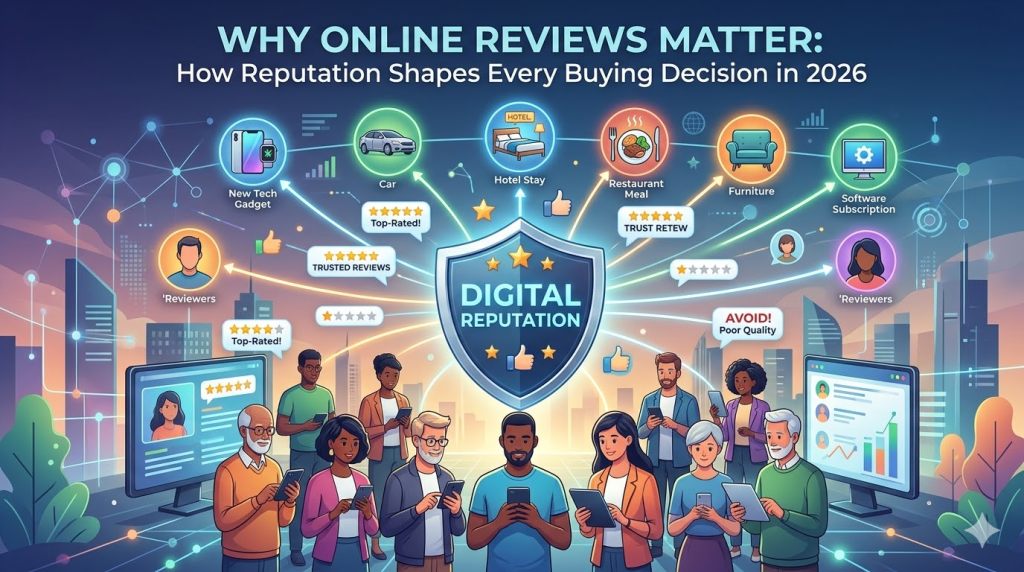
In 2026, a single one-star review can slash sales by 30%, per BrightLocal’s latest study. As consumers ditch ads for digital word-of-mouth, online reputation has become the ultimate buying decider. This article explores psychological drivers like social proof, 2026 behavior shifts including AI personalization, business revenue ties, platform algorithms, authenticity battles, emerging trends, and proven strategies to dominate the review economy.
From Word-of-Mouth to Digital Dominance
Traditional word-of-mouth influenced 20-50% of purchases. Digital reviews now drive 79% according to Stackla’s UGC study. This shift marks a profound change in how consumers make buying decisions.
Picture neighbors chatting over fences about the best local restaurant. That personal endorsement built trust through direct connections. Today, digital word-of-mouth scales this globally via platforms like Yelp and Amazon.
The evolution started with Yelp’s 2005 launch, enabling location-based feedback. By 2010, mobile apps turned reviews into on-the-go tools for quick checks. In 2026, AI-summarized feeds condense millions of opinions into instant insights.
A Nielsen finding shows 83% of people trust online reviews as much as personal recommendations. Businesses must monitor this digital reputation across review platforms. Positive star ratings boost buyer confidence and sales conversion.
2026 Projections: Reviews as the New Currency
Gartner predicts review scores will determine 90% of algorithmic product rankings by 2026, creating a $500B reputation economy. Businesses will treat customer feedback like digital gold. This shift turns star ratings into a key driver for visibility in e-commerce.
McKinsey forecasts highlight the review market valued at $50B by 2026. Platforms like Amazon and Google Reviews will dominate this space. Companies ignoring review monitoring risk losing ground in search rankings and sales conversions.
A Wall Street Journal study shows a 1-star Amazon rating drop equals 9-30% sales loss. This ROI impact pushes brands toward reputation management. Firms responding quickly to negative reviews can boost buyer confidence and repeat purchases.
Looking ahead, 2026 predictions include VR reviews for immersive product trials, blockchain for verified authenticity, and AI sentiment scoring for real-time insights. Businesses should prepare by adopting review aggregation tools. These technologies enhance consumer trust and provide competitive advantages in online shopping.
Psychological Foundations: Why We Trust Strangers Online
Cialdini’s social proof principle explains why consumers often trust peer reviews over brand claims. People look to others’ actions to guide their own, especially in uncertain online shopping environments. This dynamic shapes buying decisions in 2026, as user-generated content on platforms like Yelp and Amazon builds consumer trust.
Daniel Kahneman’s System 1 thinking plays a key role too. It describes fast, intuitive judgments where shoppers quickly scan star ratings and comments without deep analysis. This mental shortcut makes online reviews a powerful force in the decision-making process.
Three main cognitive biases amplify this trust in strangers. The upcoming sections explore social proof and related biases, the halo effect of positive ratings, and FOMO from negative feedback. Understanding these helps businesses manage their digital reputation effectively.
For example, a shopper eyeing a gadget on Amazon might skip a product with mixed reviews, favoring one praised by peers. Such patterns highlight how review impact drives purchase intent across e-commerce and local services.
Social Proof and Cognitive Biases
Robert Cialdini’s social proof shows people follow others’ actions, especially when uncertain. High star ratings on review platforms signal safety, prompting more clicks and purchases. This principle underpins much of modern consumer behavior in online shopping.
The bandwagon effect draws shoppers to popular choices. Once several positive reviews appear, others pile on, creating momentum for brand reputation. Research suggests the fourth review often tips hesitant buyers toward action.
- Authority bias favors reviews with verified badges, boosting perceived credibility on sites like Google Reviews.
- Anchoring bias lets the first review set expectations, influencing how later feedback is judged.
- fMRI studies reveal brain responses to trust signals mimic those in personal interactions.
Businesses can counter biases by encouraging verified reviews and responding promptly. For instance, a hotel using TripAdvisor badges sees stronger buyer confidence in competitive markets.
The Halo Effect of Positive Ratings
One extra star on platforms like Yelp can significantly lift revenue, per Thorndike’s halo effect. Positive ratings spill over, enhancing perceptions of unrelated aspects like service or value. This boosts sales conversion in retail trends for 2026.
A restaurant with strong star ratings often sees upticks in catering inquiries. Similarly, hotels with higher scores command pricing premiums, as shoppers assume overall excellence. Experts recommend monitoring review volume to sustain this advantage.
Negative halo works oppositely, where one poor rating taints broader views of quality. A low score on Trustpilot might deter trials across product lines. Companies should prioritize reputation management to mitigate such spills.
Practical steps include soliciting detailed feedback post-purchase. Responding to reviews on Google My Business helps repair and amplify positive halos, fostering brand loyalty and repeat purchases.
Fear of Missing Out on Bad Deals
Negative reviews create loss aversion, twice as powerful as positive gains, per Kahneman and Tversky’s prospect theory. Shoppers fear poor outcomes more than they chase upsides, stalling purchase intent. This drives hesitation even amid mostly good feedback.
One critical comment among positives can spark significant doubt on Amazon. Carts often abandon after spotting warnings in three-star reviews. Review authenticity matters, as fake reviews erode trust further.
Businesses counter with high response rates to feedback. Addressing concerns publicly on platforms like Trustpilot rebuilds consumer trust. Research suggests proactive replies reduce churn and support business growth.
In 2026, tools for review monitoring and sentiment analysis help spot FOMO triggers early. For example, a DTC brand on Shopify might highlight resolved issues, turning negatives into loyalty builders. This approach enhances digital word-of-mouth.
Consumer Behavior Shifts in 2026
Consumers now spend most of their shopping time on mobile devices, often reading several online reviews before each purchase. This shift highlights how reputation drives every buying decision. In 2026, shoppers prioritize user-generated content over traditional marketing.
Key changes include zero-trust ad avoidance, where buyers ignore paid promotions in favor of peer recommendations. Mobile dominance means quick checks on review platforms like Google Reviews shape on-the-spot choices. AI review personalization tailors feedback to individual preferences, boosting purchase intent.
Research suggests many abandon brands after one poor mobile review experience. Businesses must focus on review monitoring and rapid responses to negative feedback. Positive star ratings build trust, while fake reviews erode it.
These trends demand strong digital reputation management. Companies that adapt see higher sales conversion and customer loyalty. In 2026, social proof from reviews outperforms all else in e-commerce.
Zero-Trust Era: Skepticism Toward Ads
Only 36% trust paid ads vs 88% trusting online reviews, according to reports on advertising trust. Shoppers in 2026 show strong ad blindness, turning to authentic customer feedback instead. This creates a zero-trust era for marketing.
Many use ad blockers to skip promotions, favoring recommendations from peers. Products endorsed in reviews see higher buy rates than those pushed by ads. Trust in NGOs outpaces ads, pushing brands toward genuine word-of-mouth.
Over time, ad skepticism has grown, with predictions of further drops in consumer confidence. Businesses should invest in reputation management on platforms like Yelp and Trustpilot. Responding to reviews builds credibility over paid campaigns.
Practical steps include encouraging verified reviews and monitoring sentiment. Examples like detailed feedback on TripAdvisor sway decisions more than banners. In this environment, review authenticity becomes key to competitive advantage.
Mobile-First Review Habits
79% of smartphone users read reviews in-store, with over half completing purchases via mobile. This mobile dominance speeds up the decision-making process. Shoppers rely on quick access to Google Reviews and app ratings.
Habits show most check major platforms before buying, often scanning fewer reviews on phones than desktops. Voice search plays a role in finding local business feedback. Speed matters, as mobile users prioritize star ratings and recent comments.
Brands must optimize for mobile reviews, ensuring profiles shine on Google My Business. Negative mobile experiences can lead to instant abandonment. Positive ones drive repeat purchases and loyalty.
Actionable advice includes claiming listings and soliciting photo reviews. Real-world cases, like restaurant ratings checked via apps, show how this boosts foot traffic. In 2026, local SEO ties directly to review signals.
AI-Personalized Review Influence
Amazon’s AI review summaries boost conversion, while features like ‘People also ask’ shape search choices. In 2026, AI review personalization uses sentiment analysis and matching to deliver tailored insights. This tech filters fake reviews with high accuracy.
Machine learning models analyze patterns to predict purchases from feedback trends. Shoppers see recommendations like “reviewers like you bought this”, mimicking streaming services. Such tools enhance purchase influence through relevant customer feedback.
Businesses benefit from aggregation across platforms, spotting trends in review volume and scores. Ethical use avoids bias, focusing on diverse voices. Predictions show this driving business growth via data-driven reputation.
To leverage it, monitor review platforms with AI tools for real-time alerts. Respond to detailed feedback to improve services. In e-commerce, this personalization lifts buyer confidence and sales.
Business Impacts: Revenue Tied to Ratings
Businesses with strong star ratings often experience clear revenue gains. Research suggests that higher ratings directly tie to increased sales through better consumer trust. In 2026, online reviews shape buying decisions more than ever.
Algorithms on platforms like Google and Amazon prioritize businesses with positive customer feedback. Low ratings trigger penalties that reduce visibility. Review volume matters more than just rating scores for algorithm weight.
Companies track review impact on revenue with simple math. Higher stars mean more clicks and conversions. Businesses monitor reputation management to stay competitive in e-commerce and local search.
Preview the strong star-sales correlation ahead. Google penalties hit low-rated sites hard. Focus on gathering genuine reviews to boost digital reputation and drive business growth.
Star Rating Correlation with Sales
Experts note a clear link between star ratings and sales across platforms. A higher rating often leads to more conversions as buyers rely on social proof. This holds true in industries from retail to services.
| Platform | Star Impact | Industry Example |
| Amazon | Higher stars boost product visibility and clicks | E-commerce gadgets see more sales with top ratings |
| Strong ratings improve local search rankings | Restaurants gain foot traffic from 4+ stars | |
| Yelp | Positive reviews drive reservations and visits | Local services like salons book more appointments |
Consider a case like the Spiegel Center test. They improved to 4+ stars and saw sharp conversion gains. Such examples show how review platforms influence purchase intent.
Businesses can act by encouraging verified reviews. Respond to feedback to build trust. Track ratings on Yelp, Google Reviews, and Amazon to align with consumer behavior trends in 2026.
Algorithmic Penalties for Low Reviews
Google treats reviews as a key local ranking factor. Low scores under 3.5 stars often cut visibility in search results. This directly impacts traffic and revenue for businesses.
- Local Pack exclusion: Low-rated sites drop from top map results, losing local customers.
- Featured snippet loss: Algorithms favor high-rated content for quick answers.
- Ad Quality Score hits: Poor reputation lowers ad performance and raises costs.
Recovery stories highlight the power of improvement. One business boosted traffic after enhancing reviews. Focus on positive reviews and response strategies to regain positions.
Monitor review volume and sentiment to avoid penalties. Use tools for review aggregation across platforms. In 2026, strong reputation management ensures top search rankings and sustained growth.
Platform Power: How Reviews Rule Marketplaces
Amazon boasts 310 million active users, Google handles 2 billion searches per day, and Yelp controls a major share of review traffic according to ReviewTrackers. These platforms dominate online shopping and local searches in 2026. Their influence shapes buying decisions through user-generated content.
Businesses must prioritize reputation management across these giants. Star ratings and detailed feedback directly impact visibility and sales. Consumers rely on this social proof before every purchase.
SEO plays a key role as review signals boost search rankings. Emerging platforms add new layers to cross-platform reputation. In 2026, monitoring multiple sites builds stronger consumer trust.
Brands that respond to positive reviews and address negative reviews see better engagement. This strategy enhances digital reputation and drives repeat business across marketplaces.
Amazon, Google, and Beyond
Amazon reviews influence a massive portion of e-commerce sales; Google reviews impact local search visibility. These platforms set the standard for review impact on purchase intent. Businesses ignore them at their peril.
Here’s a comparison of key platforms and their influence:
| Platform | Users | Review Weight | Response Importance |
| Amazon | 310M active | High in e-commerce | Boosts seller ranking |
| Billions monthly | Strong for local | Key for map pack | |
| Yelp | Millions | Critical for services | 33% ranking factor |
| Trustpilot | Growing B2B | Essential for enterprise | Builds partnership trust |
| G2 | SaaS focused | Leads software decisions | Drives demo requests |
Focus on Amazon reviews for product sales and Google Reviews for foot traffic. Use Trustpilot for B2B and G2 for software to cover all bases.
Respond promptly to feedback on these sites. This practice improves brand loyalty and turns critics into advocates.
SEO and Visibility Algorithms
Google’s Vince update made reviews a direct ranking signal; they now carry significant weight in local algorithms. This shift underscores how customer feedback drives search rankings. Businesses must adapt to stay visible.
Key Google review ranking factors include:
- Review volume, aiming for steady growth over time
- Recency, with fresh feedback gaining priority
- Rating distribution, showing a realistic spread
- High response rate to all reviews
- Keyword match in review text
- Reviewer diversity from varied profiles
- Platform diversity across multiple sites
Implement schema markup to highlight star ratings in search results. For example, add structured data for aggregate ratings on your site to improve click-through rates.
Monitor these factors with review monitoring tools. Consistent efforts in reputation management yield long-term SEO gains and higher conversion rates.
New 2026 Platforms Amplifying Reviews
TikTok Shop reviews drive purchases among younger shoppers; Reddit’s communities shape decisions for durable goods. These platforms highlight 2026 trends in video reviews and forums. They expand the review ecosystem beyond traditional sites.
Profile of emerging players:
- TikTok: Video unboxings build hype; businesses encourage user clips for viral reach.
- Reddit: Subreddits like r/BuyItForLife offer peer advice; engage authentically to influence high-value buys.
- Discord: Gaming servers host real-time chats; brands host AMAs for feedback and loyalty.
- BeReal: Promotes unfiltered posts; fosters review authenticity over polished content.
- Clubhouse 2.0: Audio rooms enable live discussions; perfect for Q&A on services.
Adopt strategies like incentivizing ethical reviews on these sites. Cross-post responses to unify your digital reputation.
Track sentiment across them for omnichannel reviews. This approach captures consumer insights and supports business growth in new spaces.
Review Authenticity Challenges
Consumers face a growing authenticity crisis in online reviews. Fake reviews mislead buying decisions and erode trust in review platforms like Amazon, Yelp, and Google Reviews. Businesses must address this to protect their digital reputation.
Review authenticity challenges impact every aspect of consumer behavior. Suspicious feedback sways purchase intent, especially when star ratings seem manipulated. In 2026, spotting genuine customer feedback becomes essential for informed shopping.
Detection technologies and verification mandates offer hope. These tools analyze patterns in user-generated content to flag fakes. Platforms increasingly require proof of purchase to boost reviewer credibility.
Research suggests many shoppers skip businesses with suspected fake reviews. This hurts brand reputation and sales conversion. Proactive reputation management helps build lasting buyer confidence.
Fake Reviews and Detection Tech
Fakespot.ai detects a notable portion of fake reviews on Amazon, while ReviewMeta flags many 5-star reviews as unnatural. These tools use advanced methods to uncover fake reviews. Businesses benefit from monitoring their review volume for anomalies.
Detection tech employs several key methods. Linguistic analysis spots repetitive language, review velocity checks sudden spikes, and IP clustering reveals multiple submissions from one source. Sequential phrasing and account age patterns further expose inauthentic activity.
- Linguistic analysis examines word choice and grammar for unnatural patterns.
- Review velocity spikes signal coordinated posting campaigns.
- IP clustering groups reviews from identical locations.
- Sequential phrasing identifies copy-paste efforts.
- Account age patterns flag new profiles with suspicious activity.
Tools like Fakespot, ReviewMeta, and Blackbird.ai compare favorably in accuracy. For example, Curaleaf faced FTC fines for deceptive practices, highlighting enforcement risks. In 2026, integrating such tech into reputation management ensures competitive advantage.
Verified Purchase Mandates
Amazon’s verified purchase badge boosts click-through rates, yet only a portion of reviews carry this mark. Verification systems like Amazon’s Verified tag, Google’s Recent visitor, and Walmart’s Purchased label confirm real transactions. These build trust in online shopping.
FTC guidelines demand clear disclosure for authentic customer feedback. Platforms must label reviews properly to aid consumer protection. Businesses responding to verified reviews strengthen their digital reputation.
Verified reviews earn far greater trust from shoppers. They influence buying decisions more reliably than unverified ones. Examples include detailed feedback with photo reviews on e-commerce sites.
Looking to 2026, experts predict universal digital receipt verification. This could use blockchain for tamper-proof reviews. Such mandates will shape the future of reviews, enhancing social proof across review platforms.
Future Trends Shaping Review Influence
Video reviews convert 80% higher than text-based ones, while blockchain verification pilots are now live on Alibaba according to Deloitte. These shifts highlight how online reviews evolve to build stronger consumer trust in 2026. Buyers rely on dynamic formats for better purchase influence.
Gartner predicts that 75% of reviews will be video or AI-influenced by 2026. This trend moves beyond static text toward immersive experiences. Businesses must adapt to stay competitive in the reputation economy.
Key technologies like video, blockchain, and AI summaries lead this change. They enhance review authenticity and decision-making. Platforms integrate these for real-time social proof.
Review platforms such as Yelp and Google Reviews already test video features. This boosts brand reputation through vivid customer feedback. Expect wider adoption in e-commerce and local SEO.
Video and AR Reviews
TikTok Shop video reviews drive 5x higher conversions than text according to TikTok for Business. This format lets buyers see products in action, building buyer confidence. It transforms user-generated content into powerful sales tools.
Review evolution shows text dominating early days, shifting to images, then videos with high preference. Platforms like YouTube for gaming, Instagram Reels for beauty, and Snapchat for fashion lead. AR try-on reviews further increase shopping confidence.
Businesses can produce videos by encouraging user submissions or creating branded unboxings. Keep clips short, under 30 seconds, with clear audio. Respond to videos on review platforms to foster engagement.
- Train staff on simple editing tools for quick responses.
- Feature top videos on product pages for SEO reviews.
- Integrate AR filters for interactive try-ons.
Blockchain for Review Integrity
Alibaba’s blockchain verifies millions of reviews monthly and greatly reduces fake review risks per Ant Group. This technology uses decentralized ledgers, digital signatures, and smart contracts. It ensures tamper-proof customer feedback.
Live cases include IBM Food Trust for supply chains and ReviewChain pilots. Benefits cover immutability, cross-platform portability, and fraud prevention. This strengthens review authenticity across e-commerce.
By 2026, experts expect broader enterprise adoption. Businesses gain from verified digital identities for reviewer credibility. It combats fake reviews on Amazon and Trustpilot effectively.
- Monitor pilots on Alibaba for integration tips.
- Use blockchain for reputation management in B2B like G2.
- Pair with response strategies for negative reviews.
AI-Generated Review Summaries
Google’s AI review summaries appear for many search users, while Amazon tests generative versions per Search Engine Land. These tools process vast review volume into concise insights. They shape buying decisions quickly.
Three approaches stand out: extractive for key quotes, abstractive like GPT for new summaries, and multimodal blending video with text. Each excels in sentiment analysis. Businesses use them for auto-responses and competitor analysis.
Ethical concerns include bias amplification in feedback. Promote diversity in review aggregation to counter this. Tools aid product improvement and crisis management.
- Start with extractive summaries for quick wins.
- Test abstractive for detailed consumer insights.
- Review multimodal for video-heavy niches like beauty hauls.
Strategies for Businesses to Harness Reviews
Businesses that respond to 100% of reviews build stronger consumer trust and influence buying decisions. In 2026, effective reputation management turns customer feedback into a competitive advantage. This framework covers monitoring tools, response automation, and incentive strategies to boost star ratings and sales conversion.
Start with review monitoring across platforms like Google Reviews, Yelp, and Trustpilot. Use tools for sentiment analysis to track positive reviews and address negative reviews quickly. Automation ensures timely replies, while ethical incentives encourage more user-generated content.
Preview key tactics: claim profiles, set auto-alerts, and run UGC campaigns. These steps enhance digital reputation and support local SEO. Businesses see gains in review volume and brand loyalty through consistent effort.
Integrate review widgets on your site for social proof. Benchmark against competitors to refine approaches. This actionable plan drives business growth in the reputation economy.
Proactive Reputation Management
BirdEye and BrightLocal users report gains in review volume and star ratings through dedicated tools. A structured 10-step process helps businesses build proactive reputation management. This approach ensures review authenticity and fosters buyer confidence.
Follow these steps for reputation repair and growth:
- Claim profiles on Google Business and Yelp to control your presence.
- Monitor 15+ platforms with tools like Brand24 for real-time feedback.
- Set auto-alerts for responses under one hour to show responsiveness.
- Use template responses with 80% personalization for efficiency.
- Encourage employee advocacy, targeting 20% of staff to leave reviews.
- Add review widgets to websites for visible social proof.
- Launch UGC campaigns featuring customer photo reviews and videos.
- Benchmark competitors’ rating scores and response rates.
- Conduct quarterly audits of review signals for SEO impact.
- Maintain an FTC compliance checklist for ethical reviews.
Tools vary in features for review aggregation and analysis. Compare options to match your needs in e-commerce or service industries.
| Tool | Key Features | Best For |
| BirdEye | Sentiment analysis, automation | Multi-location businesses |
| BrightLocal | Local SEO tracking, reports | Small retailers |
| Brand24 | Social mentions, alerts | Social media monitoring |
Implement this process to reduce churn and enhance customer satisfaction. Regular audits reveal consumer insights for product improvement. In 2026, such tactics secure a competitive advantage amid rising AI reviews and video feedback trends.
Frequently Asked Questions
What is ‘Why Online Reviews Matter: How Reputation Shapes Every Buying Decision in 2026’ all about?
In ‘Why Online Reviews Matter: How Reputation Shapes Every Buying Decision in 2026’, we explore how online reviews have become the cornerstone of consumer trust. By 2026, reputation isn’t just a nice-to-have-it’s the primary driver behind every buying decision, influencing everything from product choices to brand loyalty through authentic user feedback and AI-powered review analysis.
Why do online reviews matter more in 2026 than ever before?
Online reviews matter in 2026 because they’ve evolved with advanced algorithms and verified user data, making them hyper-reliable. ‘Why Online Reviews Matter: How Reputation Shapes Every Buying Decision in 2026’ highlights how 95% of consumers check reviews before purchasing, as they provide unfiltered insights that ads can’t match, directly impacting sales and business survival.
How does reputation shape every buying decision according to this topic?
Reputation shapes every buying decision by acting as a digital word-of-mouth amplifier. In ‘Why Online Reviews Matter: How Reputation Shapes Every Buying Decision in 2026’, it’s shown that star ratings, detailed testimonials, and sentiment analysis from reviews determine trust levels, often overriding price or branding in a market flooded with options.
What role does AI play in why online reviews matter in 2026?
AI enhances why online reviews matter by detecting fakes, summarizing vast review pools, and predicting trends. ‘Why Online Reviews Matter: How Reputation Shapes Every Buying Decision in 2026’ explains how these tools make reputation data actionable, helping buyers make smarter choices and businesses refine their strategies in real-time.
Can ignoring online reviews hurt a business in 2026?
Absolutely-ignoring online reviews can devastate a business in 2026. As detailed in ‘Why Online Reviews Matter: How Reputation Shapes Every Buying Decision in 2026’, poor reputation scores lead to 70% drop in conversions, while responsive review management boosts visibility in search results and fosters customer loyalty.
How can consumers use online reviews wisely for buying decisions in 2026?
Consumers should prioritize verified reviews, check multiple platforms, and analyze patterns beyond stars. ‘Why Online Reviews Matter: How Reputation Shapes Every Buying Decision in 2026’ advises using review aggregators and AI insights to cut through noise, ensuring reputation truly guides informed, low-risk purchases.