

Digital money is no longer a future concept. It is becoming a reality as governments around the world explore new ways to modernise their financial systems. One of the biggest developments in this space is the rise of Central Bank Digital Currencies, often called CBDCs. While they are frequently compared to cryptocurrencies, CBDCs are fundamentally different.
This article explains what Central Bank Digital Currencies are, how they work, and how they differ from cryptocurrencies in simple terms.
What Are Central Bank Digital Currencies?
A Central Bank Digital Currency is a digital form of a country’s official currency issued and regulated by its central bank. It represents the same value as physical cash or bank deposits but exists entirely in digital form.
Unlike cryptocurrencies, CBDCs are backed by the government and considered legal tender. This means they must be accepted for payments within the issuing country.
Why Governments Are Developing CBDCs
Central banks are exploring CBDCs to improve payment efficiency, reduce reliance on cash, and increase financial inclusion. CBDCs also help governments maintain control over monetary policy in an increasingly digital economy.
How CBDCs Work
CBDCs function as a digital version of fiat money. They are issued by the central bank and distributed through approved financial institutions or digital wallets.
Types of CBDCs
CBDCs are generally divided into two categories.
Retail CBDCs
Retail CBDCs are designed for use by the general public. They can be used for everyday transactions like shopping, bill payments, and peer to peer transfers.
Wholesale CBDCs
Wholesale CBDCs are used by banks and financial institutions for large scale transactions, settlements, and cross border payments.
Technology Behind CBDCs
CBDCs may use blockchain or other secure digital ledger technologies. However, they are typically permissioned systems controlled by central authorities rather than open networks.
This allows central banks to monitor transactions and enforce regulations.
How CBDCs Differ From Cryptocurrencies
Although both CBDCs and cryptocurrencies are digital, their purpose, structure, and philosophy are very different.
Centralisation vs Decentralisation
CBDCs are fully centralised and controlled by central banks. Cryptocurrencies are decentralised and operate without a single controlling authority.
Legal Status
CBDCs are legal tender backed by governments. Cryptocurrencies are not legal tender in most countries and are considered private digital assets.
Supply Control
Central banks control the supply of CBDCs and can issue or remove currency as needed. Cryptocurrencies often have fixed or algorithmically controlled supply limits.
Privacy and Transparency
CBDC transactions can be monitored by authorities, which raises privacy concerns. Cryptocurrencies offer varying levels of transparency and pseudonymity, depending on the blockchain.
Stability and Volatility
CBDCs are stable because they are tied to fiat currencies. Cryptocurrencies are known for price volatility, which can create both opportunities and risks.
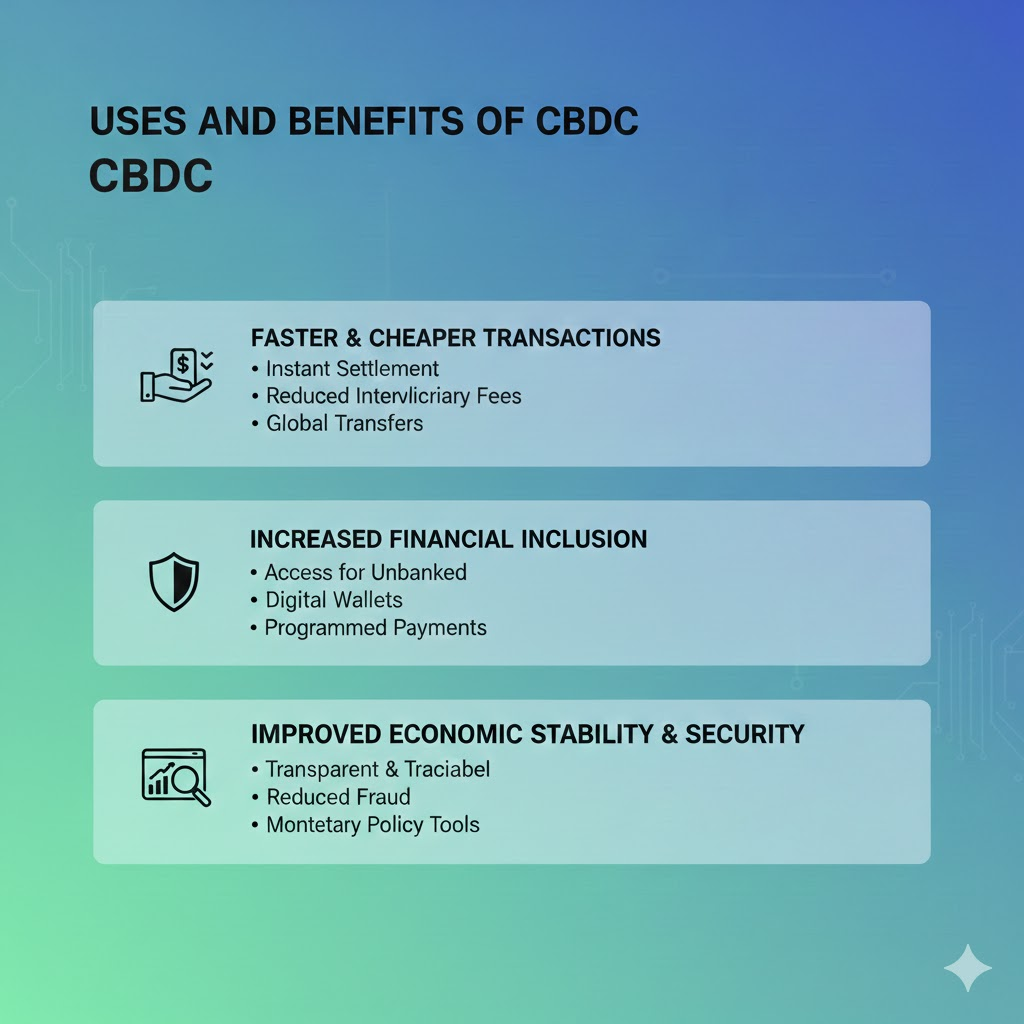
Benefits of CBDCs
CBDCs offer several potential advantages for governments and citizens.
Faster and Cheaper Payments
CBDCs can enable instant transactions with lower costs compared to traditional banking systems.
Financial Inclusion
Digital currencies issued by central banks can provide access to financial services for people without bank accounts.
Improved Monetary Policy
CBDCs give central banks more precise tools to manage inflation, interest rates, and economic activity.
Reduced Cash Handling Costs
Digital currencies reduce the need to print, transport, and secure physical cash.
Challenges and Concerns Around CBDCs
Despite their benefits, CBDCs also raise important concerns.
Privacy Issues
Increased transaction monitoring may reduce financial privacy for users.
Cybersecurity Risks
As digital systems, CBDCs must be protected from cyber attacks and technical failures.
Impact on Commercial Banks
If people hold money directly with central banks, traditional banks could face reduced deposits.
How CBDCs and Crypto Can Coexist
CBDCs and cryptocurrencies serve different purposes and are likely to coexist rather than compete directly. CBDCs focus on stability and government control, while crypto emphasizes decentralisation and innovation.
Together, they represent two distinct paths toward digital money.
What CBDCs Mean for the Future of Money
CBDCs could reshape how money moves within economies and across borders. They may improve payment efficiency, enhance financial access, and support more transparent financial systems.
At the same time, they highlight the contrast between state controlled money and decentralised digital assets.
FAQs About Central Bank Digital Currencies
Are CBDCs the same as cryptocurrencies?
No, CBDCs are government issued digital currencies, while cryptocurrencies are decentralised and privately created.
Can CBDCs replace cash?
CBDCs may reduce the use of cash, but many governments plan to offer them alongside physical currency.
Are CBDCs safe to use?
CBDCs are designed to be secure, but like all digital systems, they require strong cybersecurity measures.
Do CBDCs use blockchain?
Some CBDCs use blockchain inspired technology, but they are usually permissioned systems controlled by central banks.
Will CBDCs affect cryptocurrencies?
CBDCs may increase awareness of digital money, but they do not eliminate the need or demand for cryptocurrencies.
When will CBDCs become widely available?
Timelines vary by country. Some nations are already running pilot programs, while others are still in early research stages.
Final Thoughts
Central Bank Digital Currencies represent a major shift in how governments approach money in the digital age. While they share surface level similarities with cryptocurrencies, their goals, structure, and implications are very different. Understanding these differences helps you navigate the evolving world of digital finance with greater clarity and confidence.