 dev
Choosing the right proxy can make a significant difference to online performance, connection stability, privacy, and business operations. While residential and datacenter proxies are widely discussed, another option combines characteristics of both. These are known as ISP proxies.
ISP proxies are becoming an important choice for businesses that need reliable connections without depending entirely on traditional residential networks. They combine IP addresses registered with Internet Service Providers with infrastructure generally hosted in professional datacenters.
This arrangement offers an interesting balance. Users can benefit from consistent connections while using IP addresses associated with internet service providers rather than conventional hosting networks.
However, ISP proxies are not suitable for every situation. Their performance, pricing, IP reputation, and availability depend on the provider and intended application.
Understanding how they work and how they compare with other proxy categories can help businesses make better purchasing decisions.
What Are ISP Proxies?
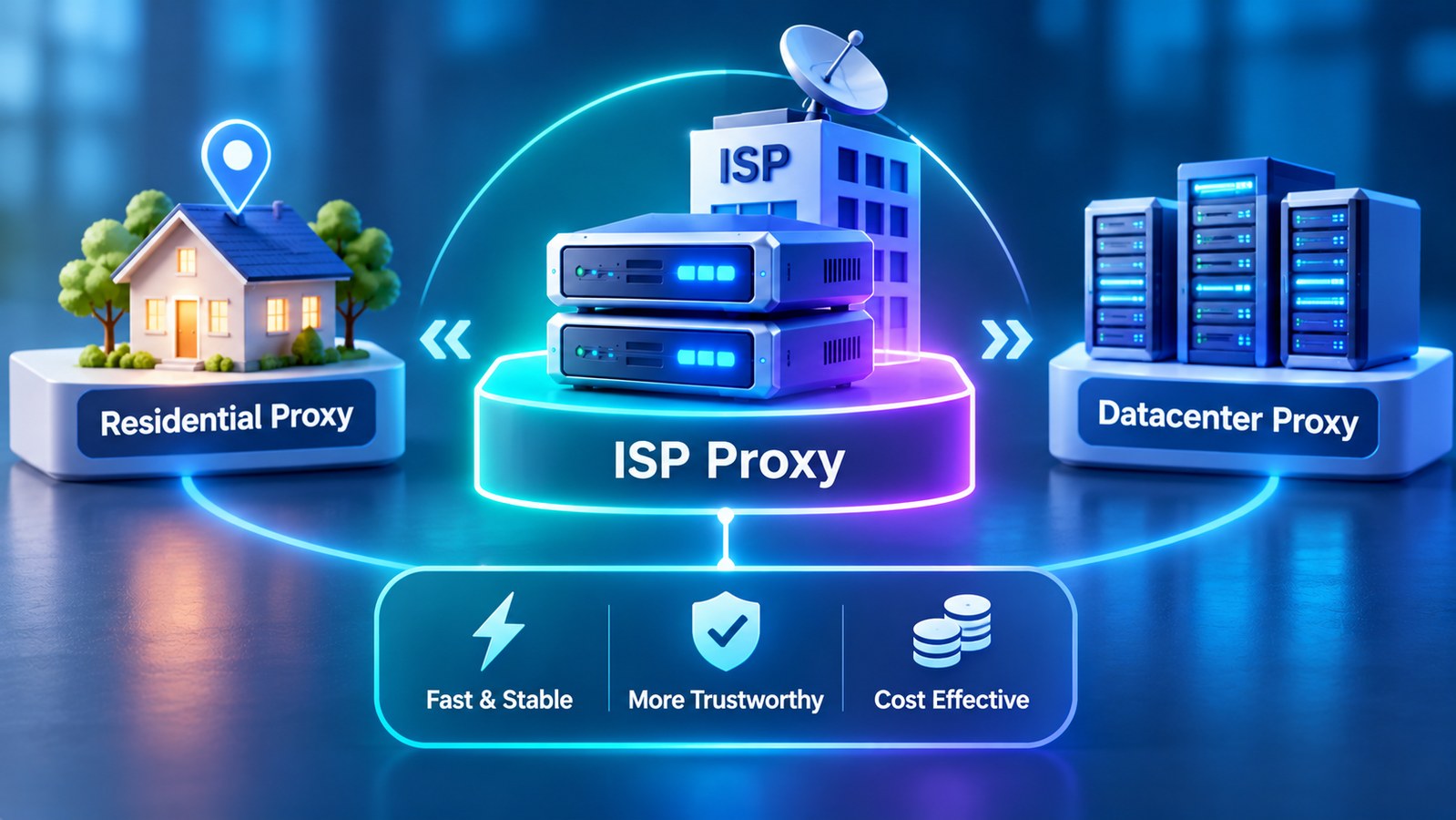
ISP proxies are proxy servers that use IP addresses registered with Internet Service Providers but are generally hosted on datacenter infrastructure.
To understand this arrangement, it helps to separate IP registration from server hosting.
An IP address identifies a device or network on the internet. Its registration information can indicate which organisation manages the address range. The physical or virtual infrastructure carrying the traffic may be located in a professional hosting facility.
ISP proxies bring these characteristics together.
For example, a business may purchase an ISP proxy that uses an address registered under an internet service provider. The proxy connection itself is maintained through a professionally managed server environment.
This makes ISP proxies different from traditional residential proxies, which use IP addresses associated with household internet connections.
They are also different from ordinary datacenter proxies, whose IP addresses are generally associated with hosting companies.
ISP proxies are sometimes marketed as static residential proxies, although the terminology and actual infrastructure can differ between providers. It is always worth checking how a service sources and manages its IP addresses before purchasing.
How Do ISP Proxies Work?
An ISP proxy acts as an intermediary between your device and the website or application you want to access.
Instead of sending a request directly from your internet connection, your application sends it through the proxy server.
The proxy then forwards the request using its assigned IP address.
Here is a simplified explanation of the process:
- You configure the ISP proxy in a supported browser or application.
- Your application sends an internet request to the proxy server.
- The proxy receives the request and processes the connection.
- The request reaches the destination website through the proxy IP address.
- The destination website responds to the proxy.
- The response is forwarded to your application.
From the destination website’s perspective, the request generally originates from the proxy IP address rather than your original public IP address.
The actual connection performance depends on server capacity, network routing, geographical distance, provider infrastructure, and the quality of the IP allocation.
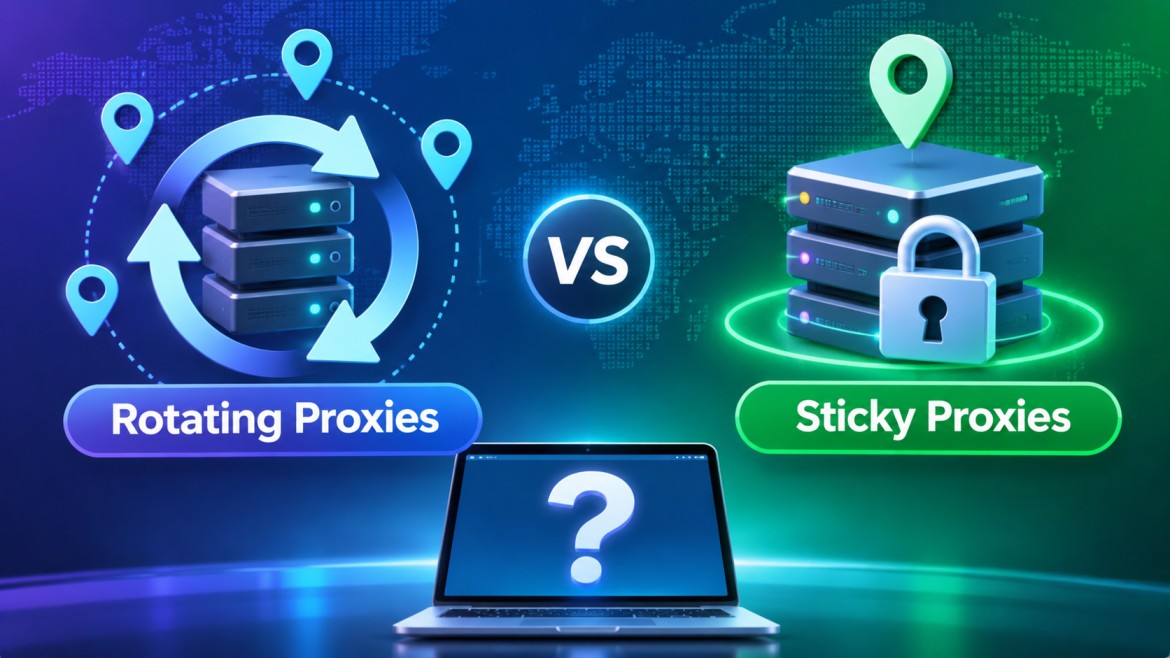
Some ISP proxy services offer static connections, while others provide additional rotation options.
ISP Proxies vs Residential Proxies vs Datacenter Proxies
Although these three proxy categories perform a similar basic function, their infrastructure and use cases are different.
ISP Proxies
ISP proxies use IP addresses registered with internet service providers while operating through datacenter infrastructure.
Their main advantage is the combination of consistent connectivity and ISP associated registration.
They are often considered when a business needs a stable IP address for repeated sessions, regional testing, and ongoing online research.
Residential Proxies
Residential proxies use IP addresses associated with household internet connections.
They are useful when testing how websites behave through residential network connections.
Many providers offer rotating residential IP pools, allowing users to access different addresses depending on their requirements.
Their main advantage is the availability of diverse residential locations.
However, performance can vary depending on the underlying network and provider infrastructure.
Datacenter Proxies
Datacenter proxies use IP addresses associated with commercial hosting facilities.
They are generally designed to provide speed, predictable performance, and cost efficiency.
Businesses may use them for software testing, website monitoring, and permitted data collection.
Some websites may apply stricter checks to datacenter IP ranges because they can identify hosting infrastructure more easily.
Speed, Trust Score and Cost Comparison
The right proxy depends on how you balance connection performance, IP reputation, and budget.
| Feature | ISP Proxies | Residential Proxies | Datacenter Proxies |
|---|---|---|---|
| Infrastructure | Datacenter | Residential network | Datacenter |
| IP registration | ISP registered | Residential ISP | Hosting provider |
| Speed | Usually high | Variable | Usually very high |
| Stability | Generally high | Depends on network | Generally high |
| IP rotation | Optional with some providers | Commonly available | Depends on provider |
| IP reputation | Depends on IP history | Depends on IP history | Depends on IP history |
| Cost | Medium to high | Medium to high | Usually lower |
| Best for | Stable sessions | Residential network testing | Speed focused tasks |
Understanding Proxy Trust Scores
The term trust score is frequently used when discussing proxy quality. However, there is no universal trust score shared by all websites.
Different platforms evaluate IP addresses using their own security systems.
They may consider:
- Previous activity associated with the IP address.
- Whether the address belongs to a hosting network.
- Geographical consistency.
- Unusual connection patterns.
- Request frequency.
- Browser and device characteristics.
- Account history.
An ISP registered IP address does not automatically receive a higher trust rating.
A previously misused ISP proxy can still face restrictions. Likewise, a properly managed datacenter IP may work perfectly well for a particular business activity.
The important factor is the actual reputation and suitability of the IP address.
What Makes ISP Proxies Useful for Businesses?
ISP proxies are particularly relevant when a business needs a consistent network connection.
Consider a company that performs regional website testing every week. The team may prefer using the same assigned IP address during repeated checks rather than switching between different residential connections.
A stable connection can make testing records easier to compare.
Here are some common applications.
1. Consistent Account Sessions
Certain authorised business workflows benefit from maintaining stable connections.
For example, a company may use dedicated browser environments for different client accounts. A static ISP proxy can provide a consistent network address for the relevant environment.
This does not guarantee that an account will avoid security checks. Platforms can evaluate several other factors, including login behaviour and account permissions.
2. Regional Website Testing
Businesses operating across several countries need to examine how their websites appear in different markets.
An ISP proxy can help teams connect through selected geographical locations.
For example, an ecommerce company may want to confirm whether its UK product pages display the correct currency, delivery information, and promotional content.
3. Advertising Verification
Marketing agencies often need to examine how advertisements and landing pages appear in different markets.
ISP proxies can support repeated regional checks where connection consistency is important.
Teams can use them to investigate differences in campaign previews, regional content, and landing page behaviour.
4. Market Research
Market research teams frequently examine publicly available product information, pricing, and industry content.
ISP proxies can provide stable connections for these activities.
Businesses should still respect website policies, applicable data protection requirements, and restrictions on automated access.
5. Website Quality Assurance
Development teams can use ISP proxies to investigate how websites respond through different network locations.
They can examine loading behaviour, regional redirects, content delivery, and other location dependent features.
This can help identify problems before customers experience them.
When Should You Choose an ISP Proxy?
ISP proxies are not automatically the best option simply because they combine residential IP registration with datacenter infrastructure.
Consider choosing one when:
- Your workflow requires a stable IP address.
- You conduct repeated regional website checks.
- Connection consistency matters.
- You need an alternative to traditional residential connections.
- Your business uses dedicated browser environments.
- You want a balance between network performance and ISP associated registration.
Residential proxies may be more appropriate when you require access to a broad pool of household network addresses.
Datacenter proxies may be more suitable when speed and affordability are the main priorities.
The decision should reflect your actual requirements rather than marketing claims.
What Should You Check Before Purchasing ISP Proxies?
Before selecting a provider, evaluate more than the advertised speed or number of available IP addresses.
IP sourcing: Understand where the provider obtains its addresses and how they are registered.
Connection stability: Review uptime information, network quality, and available performance guarantees.
Location availability: Check whether the service supports the countries and regions required by your business.
Authentication: Confirm whether username and password authentication or IP based authentication is available.
Protocol support: Check compatibility with HTTP, HTTPS, and SOCKS5 where required.
Bandwidth limits: Understand whether the subscription includes unlimited traffic or a specific data allowance.
Replacement policies: Ask what happens if an assigned IP address becomes unavailable or unsuitable.
Customer support: Look for providers that offer clear technical documentation and responsive assistance.
Usage policies: Read the service conditions and confirm that your intended activities are permitted.
Businesses comparing proxy solutions should also understand the differences between available proxy categories. The guide to proxy types, features, and selection tips provides useful context when evaluating the infrastructure, capabilities, and practical applications of different proxy services.
Common Mistakes When Using ISP Proxies
One common mistake is assuming that every ISP proxy will perform identically. Infrastructure, routing, and IP reputation differ between providers.
Another mistake is choosing a location without considering the actual testing requirement. A proxy in the correct country may still produce unexpected results if the website uses additional location signals.
Some users also overlook authentication and security settings. Proxy credentials should be stored securely and shared only with authorised team members.
Finally, businesses should not assume that a stable IP guarantees uninterrupted website access. Destination platforms maintain their own security and access controls.
Final Thoughts
ISP proxies offer a useful middle ground between residential and datacenter proxy infrastructure. Their combination of ISP registered IP addresses and professionally managed hosting infrastructure can make them suitable for businesses that value consistent connectivity.
They can support regional website testing, authorised account management, advertising verification, and market research.
However, their suitability depends on the provider, IP reputation, location availability, and intended use.
Before purchasing, compare the available proxy types, review the provider’s sourcing practices, and consider whether your workflow genuinely requires a static ISP connection.
A well matched proxy solution can improve operational consistency without introducing unnecessary costs.
Frequently Asked Questions
1. What is an ISP proxy in simple terms?
An ISP proxy is a proxy that uses an IP address registered with an Internet Service Provider while generally operating through datacenter infrastructure.
2. Are ISP proxies faster than residential proxies?
They are often faster and more consistent because they typically use professional hosting infrastructure. However, actual performance depends on the provider and network conditions.
3. Are ISP proxies better than datacenter proxies?
Neither is universally better. ISP proxies can be useful when ISP registered IP addresses and stable sessions are important. Datacenter proxies are often more affordable and offer high speeds.
4. Are ISP proxies the same as static residential proxies?
The terms are sometimes used interchangeably by providers, but the actual infrastructure may differ. Check the IP registration and hosting arrangements before purchasing.
5. Do ISP proxies have static IP addresses?
Many providers offer static ISP proxies that remain assigned to a customer for a specified period or subscription duration.
6. Can ISP proxies be used for multiple accounts?
They can support authorised account management workflows where platform policies permit such usage. Businesses should maintain appropriate account security and follow platform requirements.
7. Are ISP proxies expensive?
They generally cost more than basic datacenter proxies. Pricing depends on IP availability, geographical location, subscription duration, and provider quality.
8. Who should use ISP proxies?
Marketing agencies, ecommerce businesses, software testing teams, and research professionals may benefit when their work requires stable network connections.
9. Do ISP proxies guarantee access to restricted websites?
No. Websites maintain their own access controls and may evaluate IP reputation, account activity, and other technical signals.
10. What is the biggest advantage of ISP proxies?
Their main advantage is the combination of ISP registered IP addresses with datacenter infrastructure that can provide consistent and reliable connections.