 dev
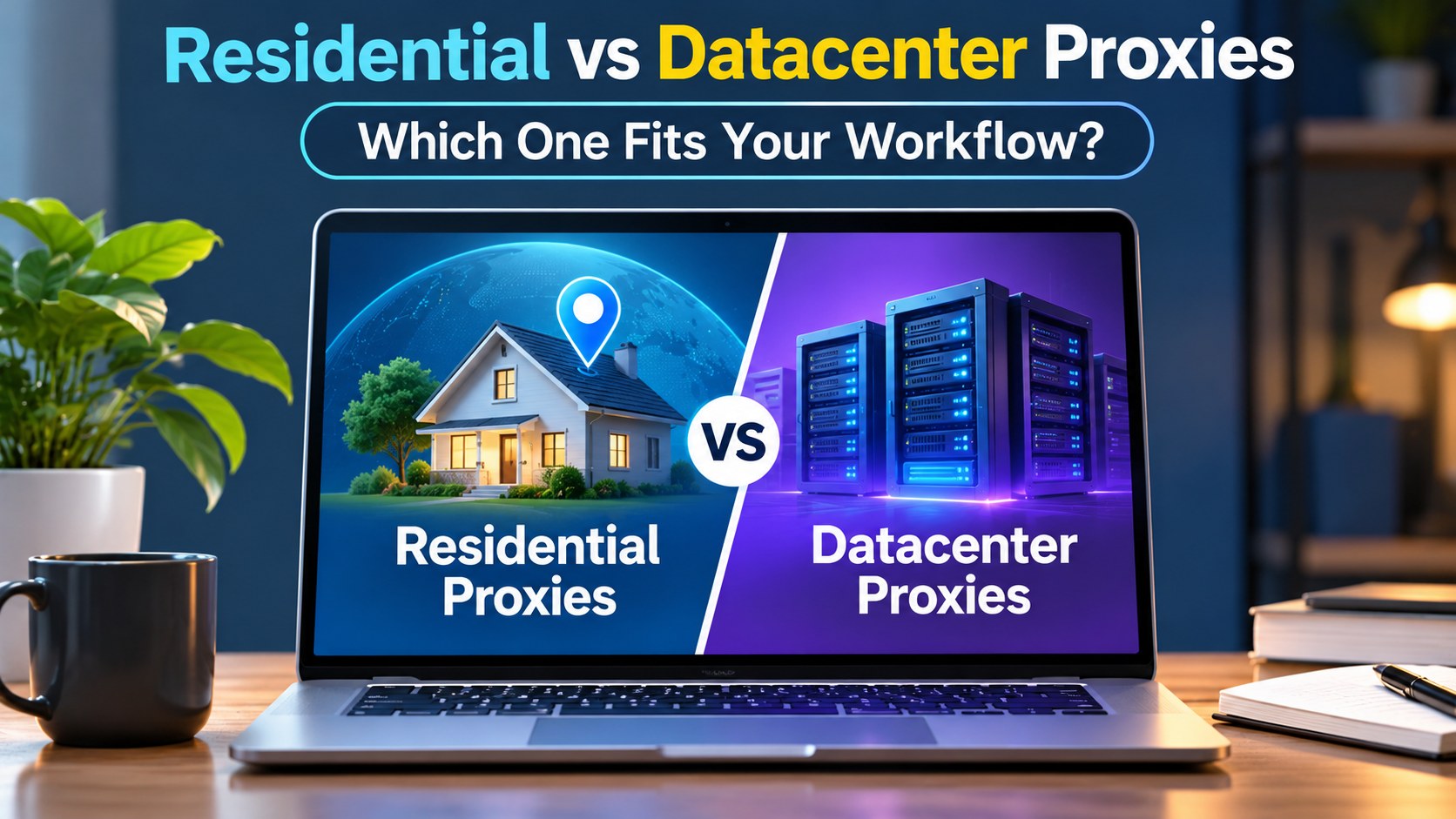
Choosing between residential proxies and datacenter proxies can be confusing, especially when both options appear to offer similar benefits. They help route internet traffic through an alternative IP address, but they differ in how their IP addresses are sourced, how they perform, and which activities they are best suited for.
For individuals, developers, digital marketers, and businesses, understanding these differences can help prevent unnecessary spending and improve online workflows.
Residential proxies use IP addresses associated with residential internet service providers. Datacenter proxies use IP addresses hosted on servers in data centres. This difference affects how websites classify connections, how quickly requests are processed, and which applications may benefit from each option.
So, which one should you choose?
The answer depends on your requirements. This guide explains how residential and datacenter proxies work, their advantages, limitations, practical applications, and the factors to consider before selecting a service.
1. What Are Residential Proxies?
Residential proxies route internet traffic through IP addresses associated with residential internet connections. These IP addresses are generally assigned by internet service providers to household devices or residential networks.
When you connect through a residential proxy, the destination website sees the proxy IP address rather than your original public IP address.
Residential proxies are commonly used for activities that require location specific access or connections associated with ordinary residential networks.
For example, a company conducting international market research may need to check how its website appears to visitors in different countries. A residential proxy can help the research team access the website through an IP address associated with the selected region.
Common Uses of Residential Proxies
- Regional website testing.
- International market research.
- Location based content verification.
- Product availability checks.
- Regional price comparison.
- Website experience testing.
- Checking how websites appear across different locations.
Residential proxy services may offer rotating or static IP options. With rotating residential proxies, the IP address can change according to a selected schedule or connection rule. Static residential options maintain the same address for a defined period, depending on the provider.
2. What Are Datacenter Proxies?
Datacenter proxies use IP addresses hosted on servers operated by data centres or cloud infrastructure providers.
Unlike residential proxies, these IP addresses are not generally associated with household internet connections.
Datacenter proxies are popular because they can provide fast, predictable connections for many technical and business applications.
For example, a developer testing a website may need to send repeated requests to check whether pages load correctly. A datacenter proxy can provide a practical connection option for this type of permitted testing.
Common Uses of Datacenter Proxies
- Website development and testing.
- Quality assurance activities.
- Checking website availability.
- Accessing public information where permitted.
- Routine business operations.
- Technical monitoring.
- Testing application connectivity.
Datacenter proxies can be available as static IP addresses or through rotating configurations, depending on the service provider.
They are often more affordable than residential proxies, particularly when users require consistent connections and higher bandwidth.
3. Residential vs Datacenter Proxies: Key Differences
Although both proxy types route internet traffic through alternative IP addresses, their underlying infrastructure creates important differences.
| Comparison | Residential Proxies | Datacenter Proxies |
|---|---|---|
| IP source | Residential internet connections | Data centre infrastructure |
| Connection identity | Associated with residential networks | Associated with hosting or server networks |
| Speed | Depends on residential network quality | Often offers high speed |
| Location options | Depends on available residential IP coverage | Depends on data centre locations |
| Cost | Often more expensive | Often more affordable |
| Rotation | Available with many providers | Available with some providers |
| Common applications | Regional research and location testing | Technical testing and monitoring |
| IP consistency | Static and rotating options may be available | Static and rotating options may be available |
The most important distinction is not simply speed or cost. It is the type of network connection represented by the IP address and whether that connection matches your intended activity.
4. Which Proxy Type Offers Better Speed?
Speed is one of the first factors people consider when choosing a proxy.
Datacenter proxies often have an advantage in speed because they operate through server infrastructure designed for high performance and network connectivity.
They may be suitable for applications that involve frequent requests, technical testing, and routine website monitoring.
Residential proxy speeds can vary because they depend on the quality of the underlying residential connection, geographical distance, network conditions, and provider infrastructure.
However, this does not mean every datacenter proxy will be faster than every residential proxy. Actual performance depends on the provider and the connection being used.
What Should You Check?
Before purchasing a proxy service, evaluate:
- Average response time.
- Connection stability.
- Available bandwidth.
- Server location.
- Network performance during peak hours.
- Compatibility with your applications.
If speed is important to your workflow, test both options under similar conditions before making a decision.
5. Which Proxy Type Is Better for Location Based Research?
Residential proxies are often useful for location based research because their IP addresses are associated with residential internet connections.
Businesses may use them to understand how websites display information across different geographical markets.
Consider an online store operating in India, the United Kingdom, and the United States. Its product availability, shipping information, promotional offers, and displayed content may differ across these regions.
A research team can use suitable regional proxy connections to review these experiences.
Residential proxies may help with:
- Checking regional website content.
- Comparing product availability.
- Reviewing local promotional campaigns.
- Understanding regional user experiences.
- Testing geographical content settings.
Datacenter proxies can also support location based testing when the destination website and testing requirements permit their use.
The appropriate choice depends on whether the research specifically requires residential network characteristics.
6. Which Is More Affordable?
Datacenter proxies are generally more affordable than residential proxies.
Their infrastructure is hosted in data centres, which can make it easier for providers to offer predictable pricing and larger bandwidth packages.
Residential proxies may cost more because of their residential IP sourcing, geographical coverage, network management, and provider operating costs.
However, the cheapest option is not always the most economical.
For example, purchasing a low cost datacenter proxy will not be useful if your application specifically requires a residential connection.
Similarly, paying for an expensive residential proxy service may be unnecessary when your work only involves routine website testing.
How to Compare Pricing
Before purchasing, check:
- Price per IP address.
- Bandwidth allowances.
- Monthly usage limits.
- Rotation charges.
- Session duration.
- Location availability.
- Additional authentication or connection fees.
Compare the complete package rather than looking only at the advertised starting price.
7. Residential Proxies for Digital Marketing and Market Research
Digital marketing teams often work with audiences across different countries. Understanding how websites and campaigns appear in different markets can help businesses make better decisions.
Residential proxies can support this type of research when regional network access is relevant.
For example, a marketing team may want to review a landing page from a particular country to check whether the correct language, currency, and promotional information are displayed.
They may also use regional connections to test website localisation and review location specific content.
Potential applications include:
Regional campaign verification: Check whether a campaign page displays the expected information in selected markets.
Website localisation: Review translated pages and regional content.
Market comparison: Examine publicly available product information across different locations.
Customer experience testing: Understand whether regional visitors receive the expected website experience.
These activities should be conducted responsibly, respecting website policies and applicable privacy regulations.
8. Datacenter Proxies for Developers and Technical Teams
Datacenter proxies can be useful for developers who need reliable connections for technical workflows.
Development teams frequently test websites, APIs, applications, and server responses before releasing updates.
Using a datacenter proxy can help simulate connections through different server locations and check how applications behave.
Common applications include:
Website Performance Testing
Developers can check whether pages respond correctly through selected proxy locations.
Application Testing
Testing teams can examine how applications communicate with external services through supported proxy configurations.
Website Monitoring
Businesses can monitor publicly accessible pages and check whether websites remain available.
Quality Assurance
Teams can test redirects, page responses, and other website functions in controlled environments.
Datacenter proxies are often a practical choice for these tasks because of their predictable infrastructure and performance characteristics.
9. Are Residential Proxies More Anonymous?
Residential proxies and datacenter proxies both help replace the original public IP address visible to a destination website.
However, neither automatically guarantees complete anonymity.
Websites can use multiple signals to evaluate connections, including IP reputation, browser characteristics, cookies, account activity, and request behaviour.
A residential IP address does not make every online activity anonymous. Similarly, a datacenter IP address does not automatically mean that a connection is unsafe.
For better privacy, consider the following practices:
- Choose a provider with transparent privacy policies.
- Avoid sharing unnecessary personal information.
- Use HTTPS websites for encrypted communication.
- Keep browsers and applications updated.
- Use strong passwords and multifactor authentication.
- Understand how the proxy provider handles connection records.
A proxy should be treated as one part of a broader online privacy strategy.
10. Can You Use Residential and Datacenter Proxies Together?
Yes. Some businesses use both proxy types because different tasks have different technical requirements.
For example, a company may use datacenter proxies for routine website monitoring and residential proxies for regional website experience testing.
A development team may also use datacenter connections for general testing and residential connections when it needs to examine how a website behaves through residential networks.
Using both types can provide flexibility, but it is not necessary for every user.
Start by identifying your actual requirements. If one proxy type meets all your needs, purchasing an additional service may not provide meaningful value.
11. How to Choose Between Residential and Datacenter Proxies
The simplest way to choose is to match the proxy type to your intended activity.
Consider residential proxies when:
- Your work requires residential network IP addresses.
- You conduct location based market research.
- You need to review regional website experiences.
- Your testing depends on residential network conditions.
- You require residential IP rotation or static residential options.
Consider datacenter proxies when:
- You need fast connections for technical tasks.
- Your work involves website testing and monitoring.
- You want a cost effective proxy solution.
- You need predictable server infrastructure.
- Your applications support datacenter proxy connections.
Before making a purchase, also check location availability, authentication methods, supported protocols, bandwidth limits, and customer support.
12. Questions to Ask Before Buying a Proxy
A little research before purchasing can help prevent compatibility issues and unnecessary costs.
Ask the provider:
- Where do the proxy IP addresses come from?
- Are static and rotating options available?
- Which countries and cities are supported?
- Does the service support HTTP, HTTPS, and SOCKS5?
- What are the bandwidth and session limits?
- How does the provider handle customer data?
- Is technical support available if the connection fails?
- Can the service be tested before purchasing a larger package?
A reliable provider should explain these details clearly and help customers understand which service is appropriate for their requirements.
Conclusion
Residential and datacenter proxies serve different purposes, and neither is the perfect choice for every online activity.
Residential proxies are useful when a workflow requires connections associated with household internet networks, particularly for location based research and regional website testing.
Datacenter proxies are often a practical option for developers, technical teams, and businesses that need fast, predictable, and cost effective connections.
The right decision depends on your application, budget, location requirements, and performance expectations.
Instead of choosing based on popularity or price alone, evaluate your workflow and test the available options. A proxy service that matches your actual requirements will provide better value and a more reliable experience.
Frequently Asked Questions
1. What is the main difference between residential and datacenter proxies?
Residential proxies use IP addresses associated with residential internet connections, while datacenter proxies use IP addresses hosted on server infrastructure. This difference affects how websites classify the connections and which applications may benefit from them.
2. Are datacenter proxies faster than residential proxies?
Datacenter proxies often provide faster and more predictable connections because they operate through data centre infrastructure. Residential proxy performance depends on the quality of the underlying residential network and provider.
3. Are residential proxies worth the higher cost?
They can be worth the cost when your activity requires residential IP addresses or location specific network testing. For routine technical tasks, datacenter proxies may provide better value.
4. Which proxy is better for web development?
Datacenter proxies are often suitable for website testing, performance monitoring, and routine development tasks. Residential proxies may be useful when developers need to test experiences through residential network connections.
5. Can residential proxies change IP addresses automatically?
Yes. Many residential proxy services offer automatic IP rotation. The rotation frequency and session options depend on the provider.
6. Do datacenter proxies support IP rotation?
Some datacenter proxy providers offer rotating IP configurations, while others provide static IP addresses. Check the available package features before purchasing.
7. Can I use residential proxies for market research?
Yes. Residential proxies can help businesses review regional website experiences, compare publicly available product information, and conduct location based research, subject to applicable website policies.
8. Are datacenter proxies suitable for business use?
Yes. They can support website monitoring, development, quality assurance, and other routine business activities where datacenter connections are appropriate.
9. Which proxy type is better for online privacy?
Both types can replace the public IP address visible to destination websites. Neither guarantees complete anonymity. Your privacy also depends on the provider’s policies, browser security, and how you use the service.
10. Can I switch between residential and datacenter proxies?
Yes. You can use different proxy services depending on your requirements. Some providers offer both types, allowing customers to select the appropriate connection for each task.
11. Are residential proxies harder for websites to identify?
Residential IP addresses are associated with household internet networks, which can make them appear different from datacenter connections. However, websites can use multiple detection methods, and residential proxies are not guaranteed to avoid detection.
12. Which proxy should a beginner choose?
Beginners should start by identifying their main activity. Datacenter proxies may be a straightforward and affordable option for basic technical tasks, while residential proxies are worth considering when residential network access is specifically required.